
A (Non-Exhaustive) List of Nonfiction Manuscript Prizes
Where, When and Why to Enter Them

This January I’m taking a small break from writing about medicine to write about writing. Don’t worry; I’ll be back to force you to think about death and illness soon enough.
If you’re just here for a list of manuscript prize submission opportunities? Click here!
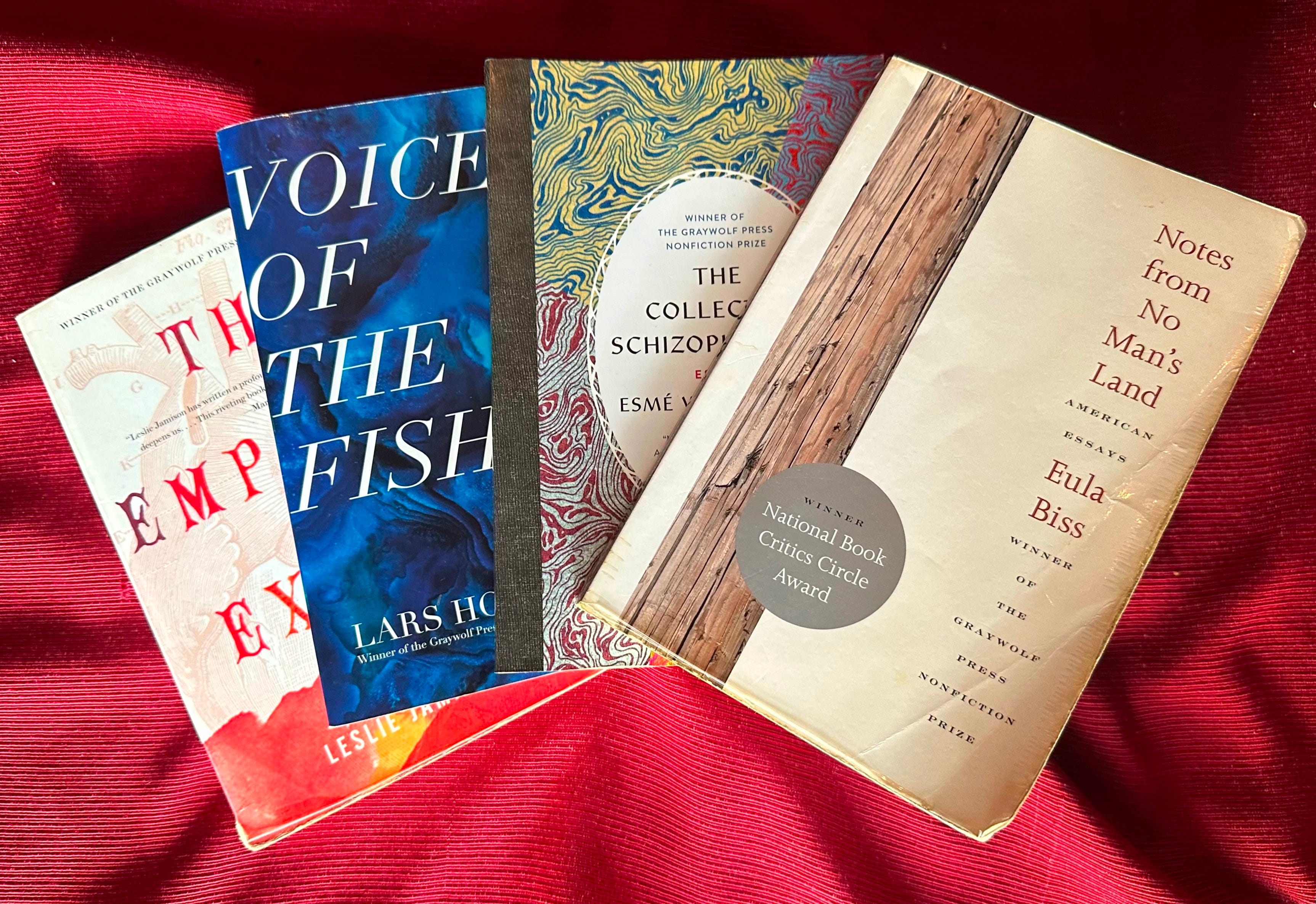
In September of 2025, Graywolf Press decided to quietly end their Nonfiction Book Prize. I had suspected this announcement was coming. The prize was not awarded for its 2024 cycle. There had been no news about a 2026 competition. But I still felt the loss of this project. I developed as a writer reading the books this prize produced: strange, invigorating essay collections and memoirs, often bound together by themes too loose or unexpected for a traditional publisher to touch. Leslie Jamison’s The Empathy Exams, Esme Weijun Wang’s The Collected Schizophrenias, Eula Biss’ Notes From No Man’s Land, Kevin Young’s The Grey Album, Ander Monson’s Neck Deep. To list these titles is to track a pivotal decade in the transformation and expansion of nonfiction as a genre. Many of these books would not have existed—certainly not with the same boundless freedom—were it not for this prize, and I doubt I would be a writer if it were not for these books.

It is hard to sell unusual books, but great things are often strange and unruly, a challenge to explain. Incredible art rarely arrives in the most optimally marketable packaging, and excellent books take both the time and the form their content demands. To be both unusual and publishable means that your quality has allowed you to slip the prevailing concerns of the market, or that you have found a unique path to publication. Often this strange path is ingrained in the texture of the book itself.
This is not a grudging article about how the Graywolf prize should have continued. Competitions and eras end, sometimes for good and understandable reasons. Instead, this article is a hope and a guide to opportunities that might rise up to fill the gap left behind. It comes in two parts. The first part includes my thoughts on when and why you should apply to a manuscript prize: how to balance the allure of the commercial market and the Big Five publishers with the promise of artistic freedom of smaller presses and prizes; how to know—or wisely estimate—when your work is ready and whether you are at the correct career stage to most benefit from these prizes. The second part is a list of nonfiction prizes and a few fellowships for funding work that has been sold, but is still being written.
I have some experience on this front. My forthcoming book, Field Guide to Falling Ill, comes out this month (January to be exact). It was the inaugural winner of the Yale Nonfiction Book Prize. An earlier draft of this manuscript was also a finalist for the 2022 Graywolf Press Nonfiction Prize—the last to be awarded. I learned a lot from winning the Yale prize; I learned even more from getting close in 2022 and working to improve a manuscript that wasn’t quite there. Naturally, I want the Yale Nonfiction Book Prize to succeed because it in turn might help the chance of my book succeeding, but I also want my book to succeed in order to help this prize. I believe in this small but essential sliver of the publishing world, and I have for many years—long before I won or even hoped to win any of these competitions. I believe in these prizes’ capacity to produce strange and incredible books that would not otherwise exist.
So here are some thoughts on WHY, WHEN, and WHERE to submit your work.
WHY
1. Greater Artistic Latitude
The number one reason to submit to one of these competitions is because your project needs the kind of artistic freedom and flexibility that a traditional publisher may be unwilling to take a risk on. This doesn’t always mean the most avant-garde or experimental forms imaginable. Sometimes it just means you want to prioritize elements other than top-line arguments with a topical hook.
I happened to be querying agents when I won the Yale Nonfiction Book Prize, and I had to decide whether to continue down the traditional publication route with this agent, someone I very much liked and trusted, or accept the award. The traditional route would have required substantial revision and expansion of a few chapters into a more traditional argumentative nonfiction book. The prize offered the opportunity to publish the book a more loosely collected collection of essays driven by voice and theme. I knew that there might be more money and marketing support in pursuing the traditional route, but I believed in this book, in its associative and itinerant form. I wanted to trust readers to make connections between chapters even when they were not explicitly spelled out.
2. Editorial Support
Most prizes offer some level of editorial support. The level of editorial development can vary with each prize, but most prizes some or significant guidance on revision and development. The opportunity to see the inside of the book development process is one of the most invaluable aspects of the experience.
3. Decent Debut Advances and Publication with Prestigious Presses
The Yale Nonfiction Book Prize includes a $15,000 advance, publication by Yale University Press within the Yale Nonfiction Prize Series, and first-serial excerpt placement in The Yale Review. The Graywolf Press Nonfiction Prize used to offer a similarly generous $20,000 advance plus a $2,000 grant.
Other manuscript prizes don’t offer advances quite this high. They often range from $1,000 to $2,500, with a few falling in between the high and low end. Still, each prize offers publication—no small benefit—and advances on par with or slightly below common debut advances with small presses.
4. Career Launch & Visibility
Winning an award establishes an author as a rising talent, increases book sales, and attracts literary agents and publishers. You generally do not need an agent to submit to these types of prizes, and they can be a great way to sign for a subsequent book. A prize win can also boosts marketing potential through media attention, a clear news peg, and promotional opportunities. And while most winners sell modestly—not a terrible fate for a debut book—some have gone on to be major best sellers. Prize recognition also opens doors to speaking engagements, teaching positions, and future book deals. Even if a book does not become a best seller the residual effects can be a pivotal moment in a writer’s career. For me personally, this was a huge draw.
WHEN
I think there are really three questions here: When is your manuscript ready? When is your manuscript competitive (slightly different)? And when are you as a writer—in both craft and career—best positioned to take advantage of these prizes?
Prize Requirements
The first question is straightforward but contingent. Each prize has its own set of requirements that extend from the structure of the prize. Graywolf, for example, asked for 100+ pages and allowed for an outline. They offered more extensive editorial guidance and development. Yale, on the other hand, requires that manuscripts be substantially completed. For me this meant every chapter was written and edited, the main arguments fleshed out, all major research completed, with only some light structural and slightly more substantial stylistic revisions yet to be completed.
I revised three of ten essays with an editor. These revisions included some restructuring, a lot of rewriting, and even more stylistic smoothing. The rest of the essays received several rounds of line and copy edits, but largely they went to print in the same form as original submission.
In short, read the prize requirements. Make sure you’re following them. And consider having a full manuscript even if the competition only asks for a sample. This will go a long way toward...
Competitiveness
Of course, it is not enough to simply meet the basic requirements. Assessing whether or not your manuscript is competitive is less straightforward. Ultimately it will depend on the strength of the competition, the editorial vision of the press and the judge, and of course those vexing peculiarities you can’t account for—did the press just select an essay collection about Medieval saints and they’re really looking for a lyric memoir? Does the judge bristle at anything written in the second person? Winning means accepting your work is strong, but you also got lucky in a field of excellent work. Losing might have nothing to do with the quality of your work.
Here’s what you can control:
1. Give Your Manuscript The Time It Needs
I love this essay from Carmen Maria Machado for a lot of reasons, but especially her thoughts on giving work the time it needs to fully mature. You get one first book. No one cares if you publish it at 31 instead of 29, 47 instead of 36. Let your manuscript fully develop, then give it another few months. You might win. This should be as exciting as it is terrifying. This must be a book you are ready to put out as your debut. It’s never really clear when a book is ready, and of course one can fall into the opposite trap of holding onto it for too long, but you shouldn’t rush. Each chapter you’re submitting should feel at least ninety-five percent done. The project should be robust, deep, mature, complete. Even if you’re only submitting the first 100 pages, the trajectory should be clear and those pages should be tight.
2. Have a Clear Vision
If your book isn’t complete, you still need a sense of the its shape, argument, structure, narrative arc, and, if relevant, the remaining work to be done. Could you pitch this book to an agent or an editor in a few sentences? What is the core idea you want to communicate? That may seem reductive, but writing is about creating an organized hierarchy of information. Great writing does that so well and so seamlessly that hierarchy becomes transparent. If you can’t put your central idea into words, your vision isn’t clear enough. You may have two projects blended haphazardly into one. You may need to write more, or you may need to clear the brush to see the shape of the thing you’re building. Whatever the problem is, you’ll need to solve it before submitting, rather than hoping the answers will come through the editorial process.
3. Develop a Mature Voice
As an undergraduate writer, I mostly wrote cheap imitations of writers I loved. I wanted to be a great writer, and I knew I didn’t have the command of craft I needed. I learned by mimicry and experimentation. I tried on different voices like clothes off the rack. Nothing quite fit, but traces from all the writers who ever influenced me stuck around, blended with the work I was doing behind the scenes to develop my own sensibility, and through the strange slow alchemy of obsession became part of what is now my style. One that doesn’t have to imitate. One that I can call up—sometimes with great effort—whenever I need it. This is how I define a mature style. It’s a voice that comes from the vast river all writers are stepping into, but it’s a current that you shape and command. It shouldn’t feel flimsy or derivative. It should feel pliable and innate, something you can bend around any topic.
4. Be Weird
These prizes are meant to support and bring strange, ambitious projects into existence. They are looking for work that traditional publishers might overlook or find too difficult to market. A lovely, but straightforward memoir or a traditional argumentative nonfiction project are probably best shopped around to agents and sold to a traditional press. For all the advantages of manuscript prizes—creative liberty, prize notoriety—there are plenty of advantages to publishing through a more traditional route (mostly a bigger advance and marketing budget). Weird doesn’t have to mean alienating, extreme, or even particularly experimental. Largely because of the books I listed in the first paragraph of this article, I don’t consider my work particularly strange. Nonfiction has changed and broadened a lot in the past ten years. But my book is unified more by theme, style, voice and an internal architecture of recurring questions and preoccupations, rather than a single high-concept question or a tidy chronological narrative.
Research what traditional publishers are looking for. If you fall outside of those parameters, and you have a clear vision for your project that you can execute with confidence and professional polish, you should submit.
5. Read Some Winners
I’d love it if you read mine! But you don’t have to. This isn’t (just) logrolling and self-promotion. You really should read some past winners to get a sense for those ineffable qualities different prizes favor and look for. And while I hope everyone is writing a collection of essays that explores the human lives behind the corporate, legal, and cultural practices that shape medicine and illness, I’d recommend finding books that are connected to your work in form, topic, style, or sub-genre.
Your Career and Artistic Development
Be selfish for a minute. Consider what this competition can do for you. How will it advance your career? Is this a step forward or is it a lateral move? Are there tangible benefits to be gained here—a decent advance, involved editorial input, a new or expanded readership? Then consider how much of an investment you’ve made into your writing and the writing community. Ask yourself a few questions about your writing practice, your career thus far, and your vision for the future.
1. Do You Actually Write?
The most important aspect is simply whether or not you have a writing practice and how it is integrated into your life.
Do you write regularly?
Do you revise seriously—as in more than simple line and copy edits?
Have you bulldozed an essay, a chapter, an entire long-form project and rebuilt it from the ground up? It’s hard to imagine your work is ready if you aren’t regularly doing these things.
Do you have a writing community? It doesn’t matter what that community looks like as long as you’re getting feedback, advice, and support.
Do you have any professional mentors? This isn’t strictly required, but it is helpful. Peers are a great resource, but more established mentors come with a perspective and set of experiences your peers may not have.
Do you have time to complete the project? Even if you’re submitting a “finished” manuscript, you’ll likely spend the entire next year editing and revising. The less complete the manuscript, the more time you should allot.
2. Do You Have a Track Record?
Most debut prizes are designed for emerging writers who have yet to establish themselves in the field or genre. Still, you should probably have some external signals that your work is ready and competitive. Some signals that you might be ready include:
Recognition through smaller awards or journal prizes
Essays published in respected venues
An MFA or similar advanced training
Of course none of this is strictly necessary, but these ways to shape both skills and the content that you will need to be competitive.
3. Does Winning Benefit You?
Submit when winning would launch your career, not when you’re already established. These prizes raise the profile of the magazines and presses that fund them. Your success is their success, and so this prize should be a genuinely valuable step forward in your career. Maybe you’re an established poet looking to move into nonfiction, perhaps you’re a novelist with an essay collection that makes sense for one of these prizes. More likely though this is your first, maybe second, book. You define yourself as an emerging writer. And winning one of these prizes would be a huge boon, not a consolation prize or status quo.

WHERE
Finally, what you really came for. Here’s an extremely non-comprehensive list of places to submit your manuscripts. I’ve focused this list on manuscript prizes and fellowships for nonfiction, because that’s the genre I know. Nonfiction projects come with unique needs and challenges, and often these books have developmental lifecycles that vary significantly from novels or collections of poetry. I’ve tried to define the genre broadly—from lyric essays to academic biography—but I’m biased toward fellowships and manuscript prizes targeted toward literary projects that might not fit neatly with more commercial or academic publishers. I’ve tried to group prizes by funding institutions. A few places like Sarabande, Ohio State University, and Black Lawrence Press offer several great competition opportunities. If you know of other prizes please feel free to send them to me, and I hope to do a part two at some point in the future with even more opportunities!
Major Manuscript Prizes
The Yale Nonfiction Book Prize
Usually, Jan 15 - Feb 15. Check their website for future submission dates.
$15,000
The Yale Nonfiction Book Prize is a biennial international prize that recognizes artful, innovative, and intellectually probing book-length works of nonfiction. Sponsored jointly by The Yale Review and Yale University Press, the prize is open to any writer who has not yet published a book of nonfiction. We seek manuscripts that tackle ambitious and under-explored subjects in vivid prose that would appeal to a broad audience. We welcome submissions in a range of categories.
The Ohio State University (Mad Creek Books)
Non/Fiction Collection Prize Ohio State
March 15 – April 15
$1,500
Winner of this annual prize competition receives publication by Mad Creek Books and $1,500. Submissions accepted annually March 15th-April 15th through The Journal.
March 1 – April 30
$1,000
The Gournay Prize selects one book length collection of essays each year to receive $1,000 and publication in the 21st Century Essays series. The award is open to all writers for first books of essays (writers may have published books previously in other genres).
March 1st – April 30th
$1,000
A vehicle to discover, publish, and promote some of the most daring, ingenious, and artistic new nonfiction work being done in the essay.
Currently no calls for submissions
This series showcases fresh stories, innovative forms, and books that break new ground in nonfiction—memoir, personal and lyric essays, literary journalism, cultural meditations, short shorts, hybrid essays, graphic pieces, and more—from authors whose writing has historically been marginalized, ignored, and passed over. The series is explicitly interested in the full array of human identity and experiences.
Currently no calls for submissions
This series showcases graphic novels, memoir, nonfiction, comic books, and more by Latinx writers and artists. The series welcomes projects with ANY balance of text and visual narrative, from larger graphic narratives to prose memoirs with images, from collections of vignettes to serial comics, in color or black and white, fiction or nonfiction.
Black Lawrence Press
The Black River Chapbook Competition
Spring Entry Period: April 1 – May 31
Fall Entry Period: September 1 - October 31
$500
Twice each year Black Lawrence Press will run the Black River Chapbook Competition for an unpublished chapbook of poems or prose between 16-36 pages in length. The contest is open to new, emerging, and established writers. The winner will receive book publication, a $500 cash award, and ten copies of the book. Prizes are awarded on publication.
Entry Period: July 1 - August 31
Early Bird Period: June 1 - June 30
$1,000
Each year Black Lawrence Press will award The St. Lawrence Book Award for an unpublished first collection of poetry or prose (short stories or essays). Novels are not eligible for this prize. The St. Lawrence Book Award is open to any writer who has not yet published a full-length manuscript in any genre. The winner of this contest will receive book publication, a $1,000 cash award, and ten copies of the book. Prizes are awarded on publication.
Entry Period: February 1 - March 31
Early Bird Period: January 1 - January 31
$1,000
Each year Black Lawrence Press will award The Hudson Prize for an unpublished collection of poems or prose (short stories or essays). Novels are not eligible for this prize. The prize is open to new, emerging, and established writers. The winner of this contest will receive book publication, a $1,000 cash award, and ten copies of the book. Prizes awarded on publication.
Sarabande
January 1 – February 15
$2,000
The Sarabande Prize in the Essay is awarded annually to one full-length manuscript of literary nonfiction: an essay collection or book-length essay. The prize includes $2,000, publication of the work, a standard royalty contract, and an introduction written by the guest judge.
April 1 – 30
October 1 – 31
$1,000
The Sarabande Chapbook Prize honors two projects of poetry and hybrid work annually. Established in 2024, Sarabande’s 30th anniversary year, the prize celebrates Sarabande’s three-decade legacy of publishing highly distilled literary forms.
Winners receive $1,000, publication, and a standard royalty contract. All winners are published in August of the year following their win.
July 1 - 31
Each year during the month of July, Sarabande offers writers and translators the opportunity to get their manuscripts in front of our editors without the mediating factors of agents or judges. Providing direct access to writers is a core Sarabande value, rooted in our long-held belief that you, writers, know best what kind of work we’re going to love.
April 1 - August 31
$2,500
Howling Bird Press, the publishing house of Augsburg University’s MFA in Creative Writing, offers an annual prize that results in book publication. This is a rotating prize that moved between nonfiction, fiction, and poetry depending on the year. The press welcomes innovative, original work from established and emerging authors. The competition is open to all writers in English living in the U.S., whether published or unpublished. Manuscript length should be between roughly 48 and 72 pages.
Autumn House Press Nonfiction Prize
March 1 — April 30
$2,500
For the 2026 prize, the Autumn House staff, as well as select outsider readers, serve as the preliminary readers, and the final judge is Ira Sukrungruang. The winner receives publication of their full-length manuscript and $2,500. The submission period opens March 1, 2026, and closes April 30, 2026 (Eastern Time). We will announce the finalists and the winner of the prize in August 2026.
August 1 — September 30
$1,000
From University of Massachusetts Press, The Juniper Prize for Creative Nonfiction is awarded annually to one original manuscript. The University of Massachusetts Press publishes the winning manuscript, and the author receives a $1,000 award upon publication.
Kellman Prize for Immigrant Literature
January 1 — May 31
$10,000
In 2015, the Restless Books Prize for New Immigrant Writing was created to honor outstanding debut literary works by first-generation immigrants whose work examines how immigration shapes our lives, our communities, and our world. For the tenth anniversary of the prize, Restless Books’ unstintingly generous board member, Steven G. Kellman—whose grandparents were immigrants to the United States—endowed the prize so that it may continue in perpetuity. The award will now be known as the Kellman Prize for Immigrant Literature. The winner receives $10,000, a writing residency from Millay Arts, and publication by Restless Books. Beginning in 2025, the prize no longer alternates between fiction and nonfiction, but accepts submissions in both genres each year.
AWP Sue William Silverman Prize for Creative Nonfiction
January 1 — February 28
$2,500
Creative nonfiction: compelling, groundbreaking memoirs and essay collections that embrace real subjects and true events through literary techniques more commonly associated with fiction or poetry. Winners of the creative nonfiction award receive a $2,500 cash honorarium from AWP and publication by the University of Georgia Press.
Zone 3 Press Creative Notifiction Book Award
On hiatus, but check back
$1,000
Fellowships and Grants
Spring
$40,000
The Whiting Nonfiction Grant for Works-in-Progress of $40,000 is awarded to writers in the process of completing a book of deeply researched and imaginatively composed nonfiction. The Whiting Foundation recognizes that these works are essential to our culture, but come into being at great cost to writers in time and resources. The grant is intended to encourage original and ambitious projects by giving recipients the additional means to do exacting research and devote time to composition. Learn about the grantees below.
The Lukas Work-in-Progress Prize
Late February
$25,000
Two J. Anthony Lukas Work-in-Progress Awards, in the amount of $25,000, are given annually to aid in the completion of a significant work of nonfiction on a topic of American political or social concern.Recognizing that a nonfiction book based on extensive original research often overtaxes the resources available to its author, the project envisions the award as a way of closing the gap between the time and money an author has and the time and money that finishing a book requires.
Applicants for the award must already have a contract with a U.S.-based publisher to write a nonfiction book. The judges will make their decision on the basis of achieving maximum impact on a promising book project. Therefore, their selection criteria will represent a blend of the merit of the book and the financial need of the author. For this reason, the judges will need to know the amount of the author’s advance, as well as any other financial support for the book, such as a grant.
Fall
$90,000
The Dorothy and Lewis B. Cullman Center for Scholars and Writers is an international fellowship program open to people whose work will benefit directly from access to the collections at the Stephen A. Schwarzman Building—including academics, independent scholars, and creative writers (novelists, playwrights, poets). Visual artists at work on a book project are also welcome to apply. The Center appoints 15 Fellows a year for a nine-month term at the Library, from September through May. In addition to working on their own projects, the Fellows engage in an ongoing exchange of ideas within the Center and in public forums throughout the Library.
A Cullman Center Fellow receives the use of an office with a computer, full access to the Library’s physical and electronic resources, and a stipend of $90,000.
February 1st
$10,000
Anglophone writers of any nationality may apply for up to $10,000 to support long-form writing in the fields of literary criticism, arts writing, political analysis, and/or social reportage. Grants may not be used to fund translation.
The Leon Levy Center for Biography
Ends February 16
$72,000
Funded by the Alfred P. Sloan Foundation, the Sloan Fellowship supports the writing of a biography on a figure from science or technology. The Sloan Fellowship comes with the same funding and support as the regular biography fellowship: writing space, full access to research facilities, research assistance and a stipend of $72,000.
June 1, 2025 — January 4, 2026.
$72,000
Fellows devote their time to their projects and participate in monthly seminars and the public events of the Leon Levy Center for Biography, including the annual lecture and the annual conference, and they are encouraged to join in the dynamic intellectual community of the Graduate Center.
If you know of other prizes I should include, please feel free to send them my way. I'm hoping to create a part two with even more opportunities!